Research · ARPG
CU-Multi Dataset
A multi-robot dataset for collaborative perception, with four synchronized robots, RTK-GPS ground truth, and dense semantic LiDAR labels across the CU Boulder campus.
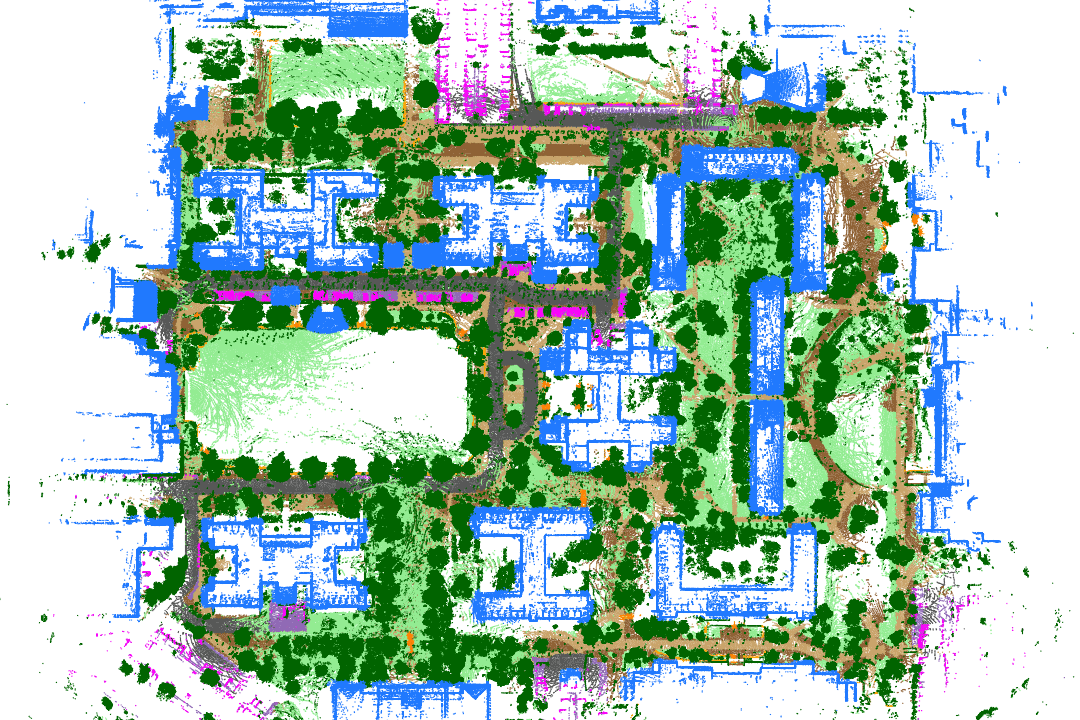
Overview
During my research, I saw that while multi-robot systems research was advancing quickly, the field had trouble benchmarking algorithms because few datasets capture realistic multi-robot team behavior. Many existing evaluations partitioned single-robot trajectories. That’s useful, but it doesn’t fully represent the collaborative perception that makes multi-robot systems effective.
This motivated me to develop CU-Multi, a dataset designed to give the research community better tools for evaluating multi-robot collaborative perception algorithms.

What CU-Multi offers
Multi-robot collaboration: The dataset has four synchronized robot runs with carefully designed overlap patterns that reflect realistic team operations. This addresses a limitation of existing datasets, where robots typically operate independently.
Full sensor suite: The dataset includes the sensors most commonly used in robotics research:
- RGB-D cameras for visual perception
- RTK GPS for precise positioning (especially valuable outdoors)
- Semantic LiDAR for 3D scene understanding
- High-quality ground-truth odometry for validation
Large-scale data collection: Data was collected over multiple days at two different outdoor sites on the CU Boulder campus. The varied environments test different aspects of multi-robot algorithms.
Standardized evaluation: A key goal was a benchmark that allows fair comparison across research groups. Controlled overlap patterns and dense semantic annotations give CU-Multi a foundation for evaluating multi-robot collaborative perception algorithms.
Publication
CU-Multi: A Dataset for Multi-Robot Collaborative Perception
Doncey Albin, Daniel McGann, Miles Mena, Annika Thomas, Harel Biggie, Xuefei Sun, Steve McGuire, Jonathan P. How, Christoffer Heckman
Under review